
This Sucks.
Whats whys and wherefores.

‘Here is the book. Take it and keep it, read it if you will, but never let me know unless, indeed, some solemn duty should come upon me to go back to the bitter hours, asleep or awake, sane or mad, recorded here.’ (Stoker, Dracula)
So this is going to be something new.
The background
Once upon a time, I was working on a book, probably actually two, about vampires. Vampires, then, were having something of a moment. Twilight was still a thing, and it felt to me that we had come around full circle, whatever that meant, in the way we vampires were occupying some cruicial spaces in the public imagination.
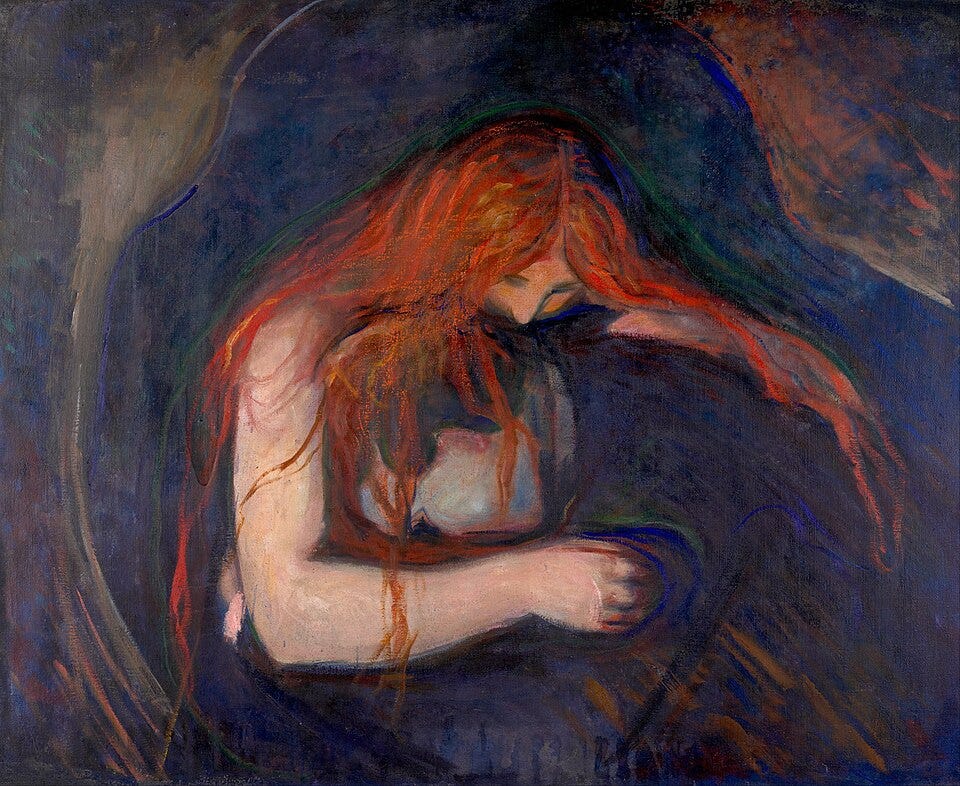
I did a lot of the background work. I watched a lot of films, read a lot of books, did a lot of research.
The plan was to write some articles and, eventually, a whole book on the way vampires exist in the cultural imagination, how our idea of vampires transformed over time and, most importantly, what these different versions of the monster say about what’s is really going on our heads at any particular time and space: the aspirations and, especially, the anxieties that drove the stories.
That was a long time ago, though. It feels like another age.
It never came to anything concrete. There’s a good reason why, or a few good whys, an interesting story, or stories, one of which you can read all about here. But if following hyperlinks isn’t your thing, here’s the even shorter version:
One morning, while working on the structural summary of what I thought would be a monograph on the topic at the local Starbucks, I ran into my friend, Tony Prescott, Professor of (variously over the years) Psychology, Cognitive Robotics, AI, and a bunch of other cool stuff. He’s very clever. I did my PhD alongside his equally brilliant wife, who studied folklore and all the other cool stuff there is to do in a university. And we got talking about robots, and he said, ‘Hey, you know about such things.. Why are we afraid of robots?’
At this point, I hadn’t thought much about robots at all. I’d read some science fiction, but it wasn’t really my speciality. But in answer to Tony’s question, I thought, and I thought about my own research, and I wondered, Well, why are we afraid of vampires? And then I just, in my head, crossed out the word
VAMPIREand put in the word ROBOTS and gave Tony that answer, which made him think well enough of my idea that he said, ‘We should do a paper together.’
The Work
And the rest, as they say…
But it’s taken me thirteen or fourteen years late to get back to look at vampires. Because I am no longer employed by the university to study robots, or AI, or anything else for that matter, I’ve had some time to look through some of my old work. (To be honest, and I am still working on questions surrounding robots and AI and the like, which you can follow here on my other Substack.)
And, it turns out, vampires are having another moment.
I’ve found that in those years so long ago I built an archive, of sorts, some of which is scribbled on bits of paper I will inevitbly lose and some in digital formats that will soon be obsolete, and some of which is just still there, floating around nebulously in my head, half-formed ideas that, like vampires themselves, transform themselves every once and a while into something concrete, and often haunt my dreams, keeping me awake long into many nights.
I think these notes will probably be of interest to a few people out there, but I am confident the ideas will be of much broader appeal. Because vampires — much like robots — are artefacts of our cultural imagination. Like ancient burial mounds or pottery. If we study these artefacts, they can tell us a great deal about the people who created them: the stories we tell through these monsters, the ideas that we put into these creatures, resonate with us for a reason. It’s not just laziness that compels us to keep telling their stories again and again. (Well, sometimes it’s laziness. Sometimes it’s just economics. But even then, the stories can be instructive nevertheless.)
Vampires are compelling monsters with compelling backstories; they are a means through which we can access a sort of cultural shorthand, through genre, through known characters; they are timeless and universal and yet specific and versitile at the same time, and because they have been around so long we accept both of these things at once, and we accept the monster in all of its incarnations.
We keep using the same monsters in our stories because they access quick truths about ourselves and our predicament. The stories change, in part, because we change, and — more importantly — because how we think about ourselves changes. We keep re-inventing these monsters because we keep re-inventing ourselves.
The Idea
There are a few reasons for posting my ideas in this form.
I’m publishing these notes because maybe, by some chance, I will find an audience interested in what I’m saying.
Perhaps it is an audience that one day may also find a book on the topic of interest. I am, in a way, then, priming my potential audience.
I want to create an archive of films and stories.
I’m going to talk about films and books and vampires as they appear in the wider ‘cultural imagination’. These aren’t just going to be ‘reviews’, though sometimes they’ll be that.
I will try, when possible, to convey the experience of the texts and films. Don’t come here for plot summaries, though sometimes they’ll be that, too. Some posts will be very short; sometimes they will inevitably be far, far, too long. Most likely, this will depend on which personae I am channelling on that day, in whose voice I am writing or in which character I am immersed.
This should be, in part, too, a ‘resource’, as so many websites that have existed in the past sought to be. Perhaps you remember the sort of thing? There were many, many sites, back in the early days of the World Wide Web, before the days when platforms like this one existed to make it easy for everyone and their cat to have a platform, back in the days when if you wanted to have a webpage you needed to be able to write in HTML and you would only do it out of some obsessive passion for something, not just because everyone else had one. You could forget about ever monetising those sites, too.
In fact, I want to make some of those past efforts part of the story and bring those past experiences into our own re-experiences today, to celebrate fandom as well as, like Van Helsing himself, scrutinising the vampire with academic, scientific rigour.
I want to start a conversation.
You are very welcome to just sit here, quietly, and read. But I know, too, that there are a lot of vampire fans out there. It’s a fandom for which I have a tremendous respect, with amazing enthusiasm and an incredible body of knowledge. Which leads me to my final aim…
I want this to be an experiment in participatory research.
My last job in academia involved, in part, looking at concepts of participatory design and participatory research. I got to do a lot of what they call ‘public engagement’, which just means talking to people and sharing ideas with ever-wider circles. And it led me to certain ideas.
One of those ideas is that I’m not really sure I want to just write ‘a book’ about the cultural history of vampires.
Research shouldn’t be done by people squirrled away on their own, reading and writing stuff based on a mysterious alchemy, and suddenly emerging years later with a completed monograph, a social disorder and poor self-grooming habits. That’s how you get the sort of research we get, on topics of varying interest and importance but inevitably buried in the sterile ground of Lacanian theory with titles that writers think are hilarious but literally no one ever reads.
So…
The Hope
This is something of an experiment. Not something that no one else has ever done, but nevertheless, some new ground on how to ‘do academic’ work
without being an ‘academic’ (i.e. ensconced in an ivory tower - other building materials are available), but…
while doing ‘scholarly’ work — i.e. work that is intelligent, critical and beyond just speculative journalism, and…
while writing in a way that a wider group of people might actually want to read, while…
using specific themes to explore wider issues of broader interest in our contemporary society.
‘Research’ should be something we all do. Together. In conversation.
Research done like this can be messy. It can be harder to quantify and align with clearly laid objectives. It is harder to navigate an intensive peer-review process for publication in a prestigious journal. But since I don’t want to publish this in a prestigious journal, and I don’t have clear objectives, and I don’t plan on measuring outcomes, and, as will be immediately evident to everyone, I kinda like things messy, none of this bothers me.
More seriously, that other way of doing research is great. I still have a lot of respect for it. But it was a particular system built to serve a particular way of working — a ‘mode of production of knowledge’, if you will — and while it’s still valid, we don’t need to be bound by that anymore. I think it’s time to try doing serious things in different ways.
Finally, the small print
Speaking of monetisation, I should add that I am shamelessly asking you to sponsor this Substack. A man’s gotta eat. My daughter’s ice hockey sticks aren’t cheap. I’ll try to make at least part of most posts free, and some free in their entirety. But I would be very grateful if you could sponsor this work and let me keep it going.